Quick Facts
- 2026 Pricing: General admission tickets range from €13 to €15, while immersive night tours are priced at approximately €25.
- Free Entry Window: Visitors can access the Mosque-Cathedral of Córdoba for free between 8:30 AM and 9:30 AM, Monday through Saturday.
- Must-See Feature: The legendary hypostyle hall in Córdoba contains 856 columns crafted from precious stones.
- Seville Highlight: The Royal Alcázar remains an active royal residence, offering a living history of the Mudéjar style.
- Photography Window: Plan your shoot between 10 AM and 12 PM to capture the most evocative natural light filtering through ancient arches.
- Travel Logistics: Córdoba is a comfortable 45-minute high-speed train ride from Seville, making it a perfect addition to any 2026 guide to visiting the Mosque-Cathedral of Córdoba.
The most iconic examples of Moorish architecture Spain are found in the heart of Andalusia, specifically within the cities of Córdoba and Seville. The Mosque-Cathedral of Córdoba stands as a masterpiece of the Umayyad dynasty, defined by its red-and-white horseshoe arches and an expansive hypostyle hall. Meanwhile, Seville offers a different perspective through the Royal Alcázar and the Iglesia de Santa Catalina, which showcase the Mudéjar style—a brilliant architectural fusion where Islamic craftsmanship meets Christian structural needs.
The Living Palimpsest: The Evolution of Al-Andalus Design
To walk through the sun-drenched streets of Andalusia is to read a stone diary of a vanished empire. From 711 to 1492, the region known as Al-Andalus served as a crucible of cultural hybridity. Here, architecture was never merely about shelter or even religion; it was a physical dialogue between the East and the West. When you look at the intricate geometric patterns and the flowing Kufic script carved into plaster walls, you are seeing the marks of a society that prioritized mathematics, poetry, and beauty as divine pursuits.
At its historical zenith in the 10th century, the city of Córdoba reached a population of approximately 500,000, establishing it as the largest and most cultured urban center in Europe. This atmospheric pressure of intellect and art produced a unique aesthetic that we now identify as Moorish architecture Spain. It is an style characterized by internal focus, where plain exterior walls hide lush courtyards and sophisticated water features, reflecting the Islamic concept of the paradise garden.
Understanding how to identify Islamic architectural features in Spanish churches is half the joy of exploring this region. Often, a building that looks like a standard Gothic cathedral from a distance reveals its secrets upon closer inspection: a row of polylobed arches hidden in a cloister or a tower that was clearly once a minaret. These layers tell the story of a land that changed hands many times but never truly lost its Moorish soul.
The Mosque-Cathedral of Córdoba: A Forest of Stone
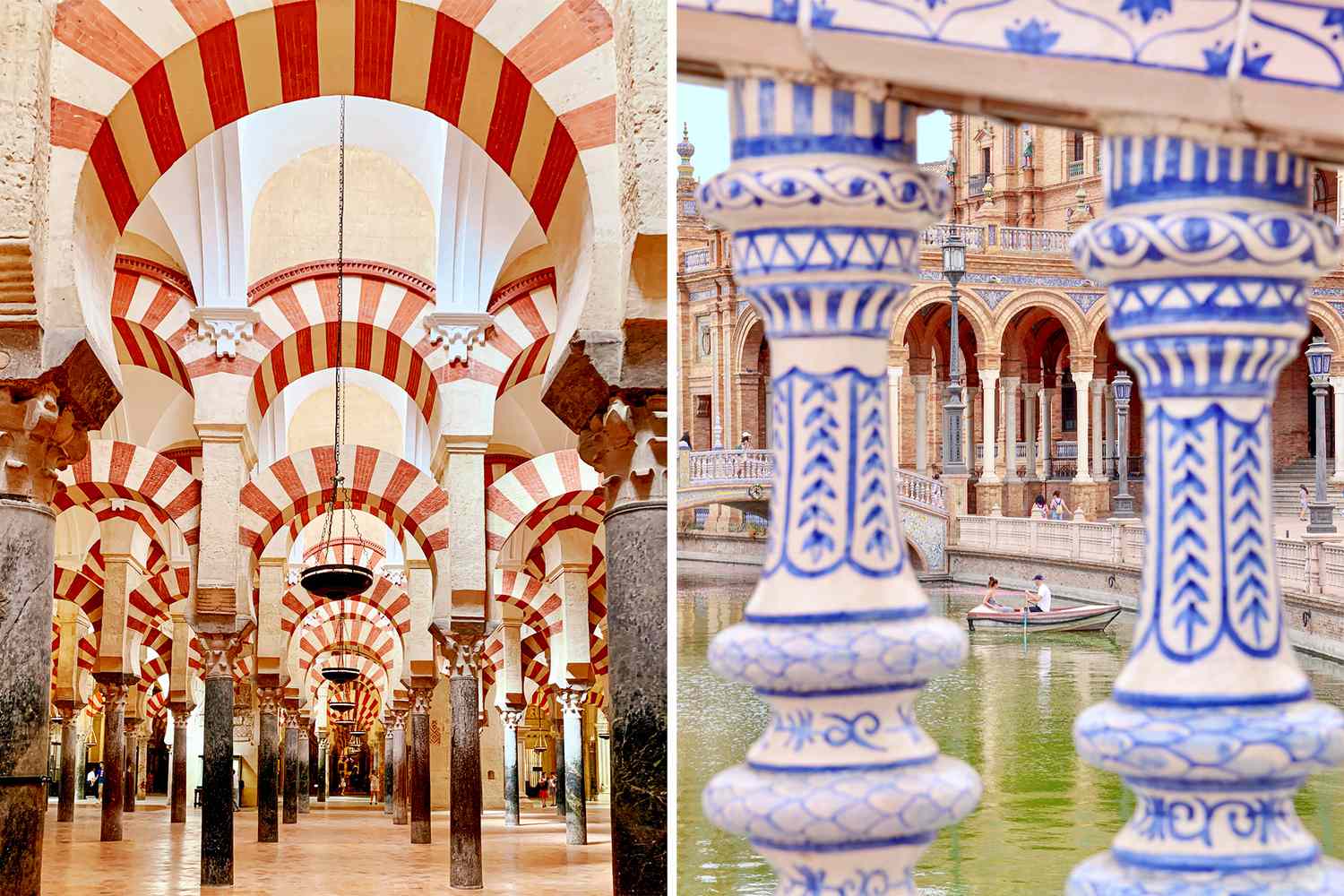
Stepping inside the Mosque-Cathedral of Córdoba is an exercise in sensory overwhelm. The air is cool, and the space seems to expand infinitely in the shadows. The Great Mosque features a vast hypostyle hall supported by 856 columns made of jasper, onyx, marble, and granite. These columns are connected by a system of two-tiered, red-and-white horseshoe arches that seem to ripple like waves across the 24,000-square-meter footprint.
If you are planning an architectural day trip from Seville to Córdoba, prepare to witness the ultimate "building within a building." In the 16th century, a Renaissance cathedral nave was inserted directly into the center of the mosque. While this act was controversial even at the time, it created a surreal juxtaposition where Baroque altarpieces meet 8th-century Islamic engineering. It is an architectural landscape that defies logic but commands reverence.
When navigating your Mosque-Cathedral of Córdoba visiting tips for a 2026 journey, don't miss the Patio de los Naranjos. This courtyard, filled with orange trees and trickling fountains, was originally the place for ritual ablutions. Today, it remains a tranquil transition zone where the scent of citrus blossoms prepares the mind for the grandeur of the interior. The way the natural light interacts with the double-tiered arches creates a rhythm of shadow and gold that has inspired poets for over a millennium.
Seville’s Royal Alcázar: The Pinnacle of Mudéjar Style
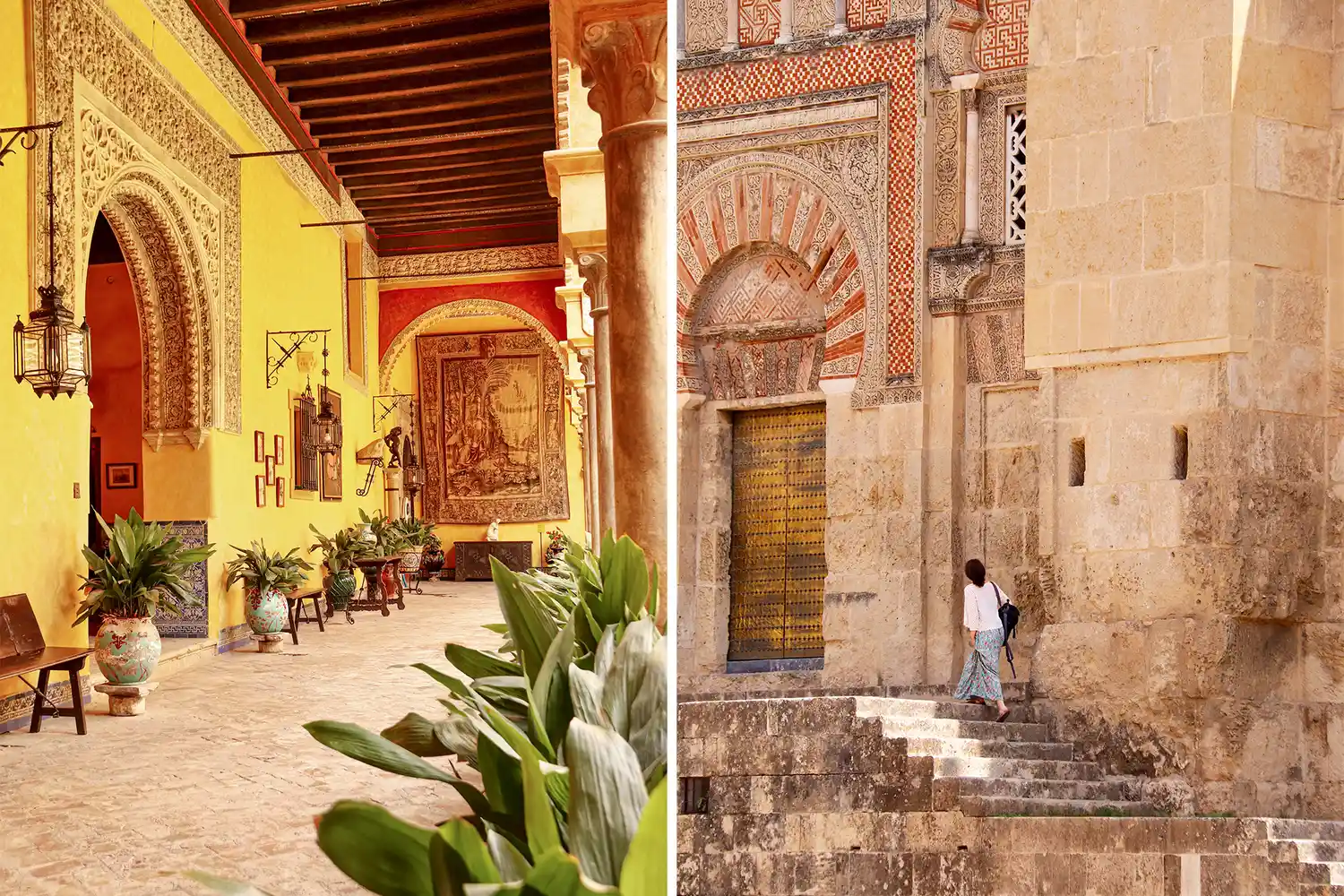
While Córdoba offers the purity of the Umayyad era, Seville provides the most exquisite examples of the Mudéjar style architecture Seville is famous for. The Royal Alcázar, originally a 10th-century fortress, evolved into a royal palace that is still used by the Spanish monarchy today. It is perhaps the most romantic building in Spain, a place where lace-like plasterwork meets vibrant azulejo tiles.
When searching for the best examples of Mudéjar architecture in Seville to visit, your path should lead you directly to the Palacio de Don Pedro within the Alcázar. Here, Christian kings employed Muslim craftsmen to build a palace that felt like an Islamic paradise. Look up to see the breathtaking artesonado ceilings—intricate, interlocking wooden designs that represent the heavens. The craftsmanship is so fine it feels less like carpentry and more like jewelry on a grand scale.
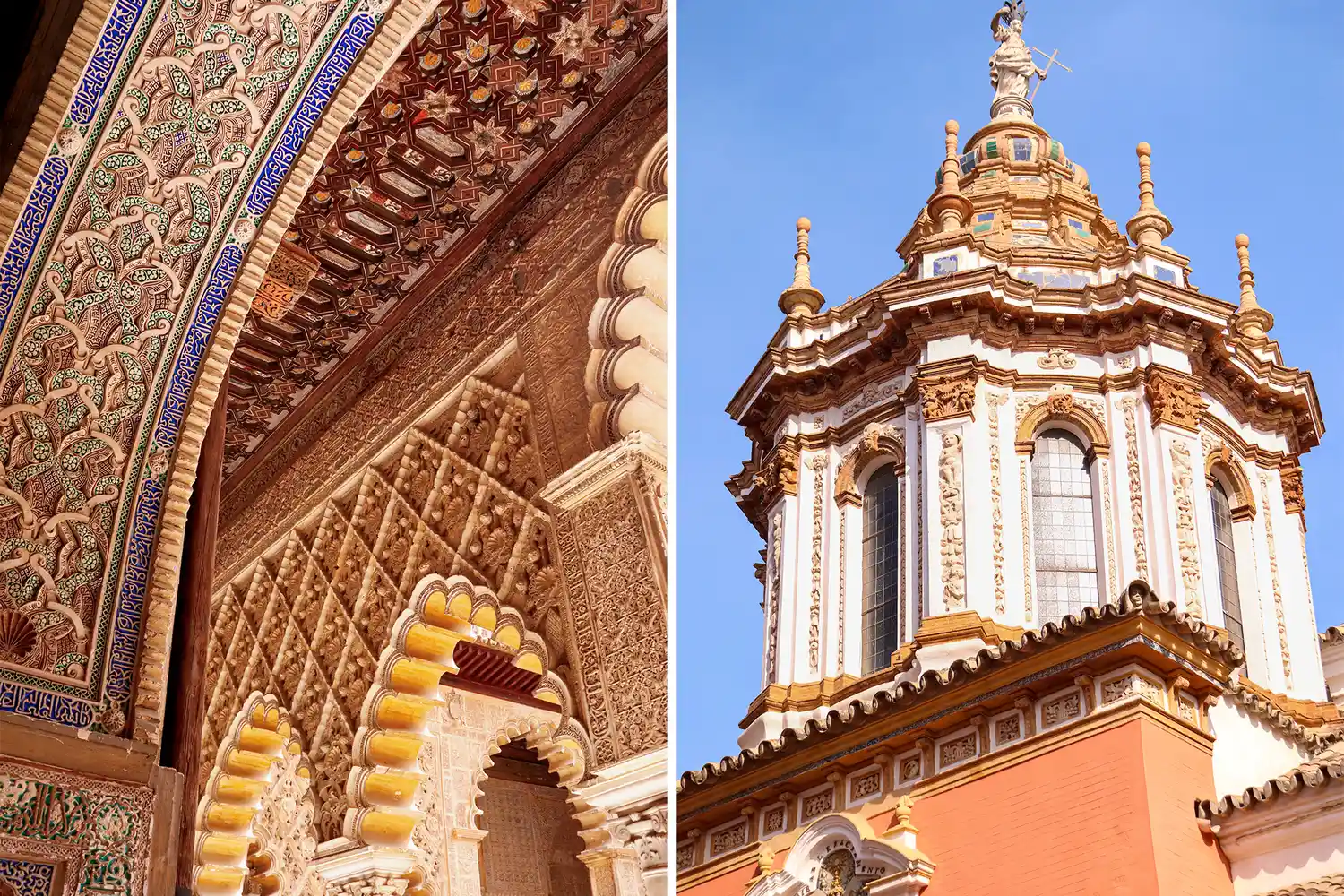
Beyond the palace walls, the city’s streets hold smaller treasures. The Iglesia de Santa Catalina is a prime example of how these styles merged; its bell tower retains the clear silhouette of a minaret, and its facade features the distinct brickwork patterns of the Almohad period. These sites prove that the Moorish influence was never fully erased; it was simply woven into the fabric of the Spanish Renaissance and Baroque.
Moorish vs. Mudéjar: A Visual Grammar for Travelers
For the modern traveler, distinguishing between these periods can be a challenge. When comparing Moorish and Mudéjar styles for Spanish travelers, the distinction usually lies in who the building was built for and who did the labor. Moorish architecture refers to the original structures built during the various Islamic dynasties, while Mudéjar refers to the work of Muslim craftsmen living under Christian rule.
| Feature | Moorish Architecture | Mudéjar Architecture |
|---|---|---|
| Era | 8th - 13th Century | 12th - 16th Century |
| Primary Material | Stone, marble, and plaster | Brick, wood, and ceramic tiles |
| Key Arches | Simple horseshoe and polylobed arches | Pointed arches mixed with Islamic motifs |
| Ornamentation | Heavy use of Kufic script and muqarnas | Heraldic shields and Gothic-hybrid patterns |
| Focus | Mosque and fortress construction | Palaces and Christian parish churches |
The use of muqarnas—the "honeycomb" or "stalactite" vaulting—reached its zenith in the later Moorish periods, as seen in the Alhambra in Granada. This UNESCO World Heritage site reached a record of 2.6 million visitors in 2023, proving that the allure of this intricate geometry remains as strong as ever.
Framing History: 2026 Photography & Practical Guide
Capturing the essence of Moorish architecture Spain requires more than just a good camera; it requires an understanding of light. The original architects designed these spaces to be illuminated by soft, indirect light that emphasizes the texture of the stone. For the most successful Andalusian Moorish landmarks photography, aim for the mid-morning hours. In Córdoba, the light hits the red-and-white arches at an angle that creates a sense of depth impossible to capture at high noon.
Practical photography tips for Andalusian Moorish landmarks often suggest leaving the tripod at home, as they are generally prohibited in the interior spaces of the Alcázar and the Mosque-Cathedral. Instead, lean against a column (carefully!) or use a fast lens to manage the dim interiors. Focus on the repetitive nature of the arches to create a sense of rhythm in your composition.
By 2026, new security protocols may be in place, so always book your tickets at least a month in advance. If you have extra time in Córdoba, your ticket often includes the Fernandine Churches route, which takes you through historical neighborhoods to see smaller, often overlooked examples of Gothic-Mudéjar transitions. For a truly immersive experience, the "Soul of Córdoba" night tour offers a light and sound show that highlights the building's layers in a way that daytime crowds miss.
FAQ
What are the main characteristics of Moorish architecture in Spain?
The primary features include the iconic horseshoe arch, polylobed arches, and the use of intricate geometric patterns instead of figurative art. You will also see heavy use of courtyards with water features, decorative plasterwork known as yeseria, and artesonado wooden ceilings.
What is the difference between Moorish and Mudejar architecture?
Moorish architecture was created by and for the Islamic rulers of Al-Andalus. Mudéjar architecture refers to the style that emerged after the Reconquista, where Muslim craftsmen were hired by Christian patrons to build palaces and churches, resulting in a fusion of Islamic techniques and Christian silhouettes.
What is the most famous Moorish building in Spain?
The Alhambra in Granada is arguably the most famous example, though the Mosque-Cathedral of Córdoba is equally significant for its age and scale. Both represent different peaks of Islamic architectural achievement in the Iberian Peninsula.
What are the top Moorish landmarks to visit in Seville?
The Royal Alcázar is the primary destination, featuring some of the most beautiful Mudéjar rooms in the world. Other key sites include the Giralda (the former minaret of the city's main mosque) and the Torre del Oro along the river.
Why did the Moors use horseshoe arches in their buildings?
While the horseshoe arch was actually used by the earlier Visigoths in Spain, the Moors refined and popularized it as a central aesthetic element. It provided greater height and stability for their vast hypostyle halls while creating a unique visual rhythm that became synonymous with Islamic design in the West.